
Budget-Friendly Email Verification API for EdTech Apps
Verify email addresses for your edtech app with a cost-effective API that delivers 98.9% accuracy. Reduce bounces, improve deliverability, and scale without ove
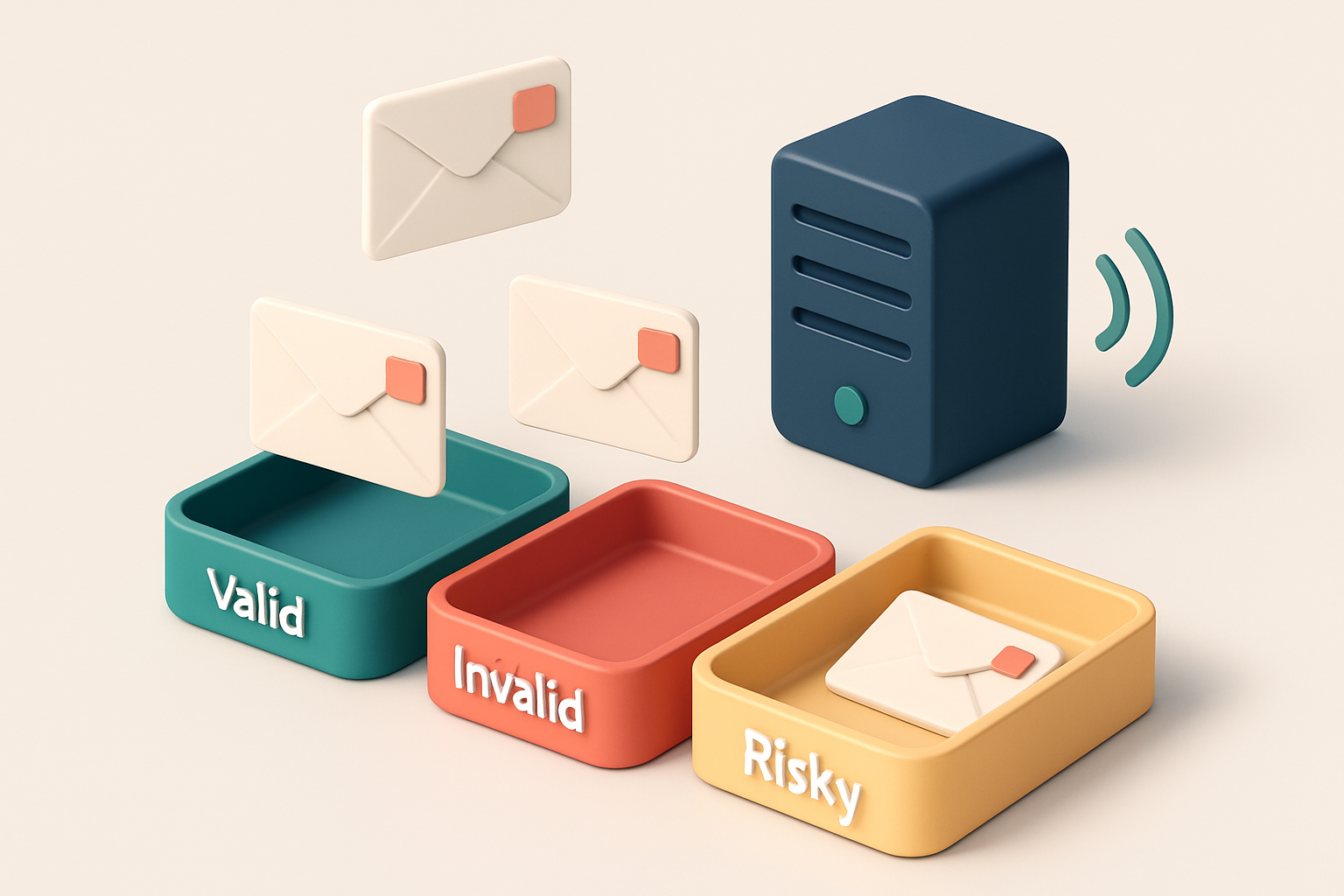
Why EdTech Apps Can’t Afford to Send to Invalid Emails
You send a welcome email to a new learner. The system says “delivered.” But it never shows up in their inbox. Not because of spam filters—but because the email was never real.
In a 10,000-user list, one invalid address isn’t just noise. It inflates your bounce rate, weakens sender reputation, and can trigger deliverability blacklists. For EdTech apps, where every onboarding message, reminder, and progress update depends on inbox placement, sending to fake, role, or disposable emails is like sending a letter to an empty house.
That’s why the right email verification API isn’t a luxury—it’s a core part of reliable delivery. A budget-friendly email verification API for edtech apps lets you filter out bad addresses before sending, protecting your reputation and getting real users the messages they need.
Key takeaways
- Invalid emails in bulk lists increase bounce rates and risk sender reputation damage
- EdTech success hinges on inbox placement for onboarding, reminders, and retention
- Verifying emails in real time before sending prevents waste and keeps deliverability healthy
The Hidden Costs of Cheap or Inadequate Email Verification
Let’s talk about what happens when you cut corners on email verification. You save a few dollars upfront, but the trade-offs pile up fast—especially for edtech apps where every user counts. A cheap tool might claim 85–90% accuracy, but that 10–15% gap means valid student or teacher emails get rejected. These are real people trying to sign up, and each false negative is a lost opportunity.
False Positives Drain Your User Onboarding
Low-accuracy tools often flag legitimate academic domains—especially those with nonstandard formats or role accounts (like [email protected] or [email protected])—as invalid. You’re not just blocking fake emails; you’re blocking real users. That adds friction where you already have a high drop-off rate. One study from the University of California found that even a 2% increase in sign-up friction can reduce conversion by over 16%. For edtech, where user acquisition is competitive, that’s not just a number—it’s lost growth.
Free Tools Don’t Scale with Your Product
Free verification services usually offer no real-time API access. You’re stuck downloading CSVs, waiting for batch results, and manually filtering outputs. That’s fine for one-off checks, but not when you’re onboarding hundreds of teachers a day via school partnerships. Without automation, your onboarding pipeline slows to a crawl. And every minute lost is a classroom that doesn’t get access to your platform. Without accurate list hygiene, your sending practice becomes inefficient. Senders that repeatedly send to invalid or poorly verified addresses risk being flagged by major providers. ISPs like Gmail and Outlook use sender reputation metrics—based on bounce rates, engagement, and blocklist status—to decide whether to deliver your messages to the inbox or the spam folder. If your domain reputations degrades over time because of bad addresses, even valid emails start getting filtered silently. This happens slowly, but it’s hard to reverse. And here’s the catch: once you’re on a blocklist or have a weak sender reputation, it takes weeks or months to clean up—especially if the domain is shared across multiple campaigns or tools. Let’s be honest: the cheapest option rarely delivers real value. The most cost-effective solution is one that gets you past the first obstacle—user acquisition—without burning down your domain reputation. Real-time email verification API lets you validate every address the moment someone signs up, catching errors before they reach your send queue. With a 98.9% accuracy rate and full control over list health, you eliminate the hidden costs of poor verification. It’s not just about filtering bad emails—it’s about preserving inbox placement and maintaining trust with every email provider. Bulk verification also lets you clean up existing lists at scale, ensuring you’re not sending to ghosts. Over time, this keeps your deliverability strong and your campaigns effective.
What Makes an Email Verification API Truly Budget-Friendly for EdTech
Let’s cut through the noise. A budget-friendly API isn’t just cheap—it’s predictable, reliable, and built for scale without surprise costs.
Cost Predictability Keeps Budgets in Control
- You need real-time validation during onboarding, but you don’t want your billing to spike when a campaign goes viral. A flat rate per verification—no per-message fees, no hidden tiers—lets you budget accurately.
- Unlike some tools that charge extra for bulk processing or charge based on delivery attempts, a transparent pricing model means you know exactly what each check costs upfront. SMTP standards define the baseline for reliable email transmission, and your validation tool should follow predictable, measurable rules.
Credits That Don’t Expire? That’s Real Savings.
- When you buy verification credits, they should last. Many providers expire after 90 days—meaning unused verifications are lost. With no expiry, you can store credits for seasonal campaigns, onboarding surges, or future product launches without waste.
- Start with 100 free verifications, then buy more in chunks that match your usage. No rush to spend. No penalties. You control the timing. Pricing pages are transparent—no fine print buried in terms.
Accuracy isn’t a luxury—it’s a cost factor. Too high, and you pay more per thousand. Too low, and you let bad data slip through.
High Accuracy, Sustainable Cost: The 98.9% Balance
- Our verification engine hits 98.9% accuracy at scale. That’s high enough to trust when you're building user trust through secure onboarding, but low enough to keep your per-1,000 cost practical for edtech apps with frequent user signups.
- Many edtech platforms see 5–15% of email addresses as invalid or risky—especially those from educational domains with role accounts or auto-generated student emails. A tool that flags risky or catch-all addresses *before* sending saves you from blacklisting.
- Real-time API access lets you validate during registration. Use the API to check addresses instantly, reduce bounce rates, and improve inbox placement over time.
“The right tool doesn’t just clean data—it strengthens sender reputation.”
Let’s be clear: no tool prevents every bounce. But a strong verification layer—combined with proper SPF/DKIM setup—means more emails land in the inbox, not the spam folder.
How Email List Validation Delivers High Accuracy at Low Cost
You don’t need to pay top dollar for accurate email validation. At its core, our email verification API uses a precise sequence of technical checks—SMTP handshake tests, MX record validation, DNS lookups—to confirm an address is both syntactically valid and technically deliverable. This layered approach catches problems early, reducing bounce rates without requiring expensive infrastructure.
Smart Detection for Real-World Edge Cases
Let’s be honest: not all "valid" email addresses are useful. Catch-all domains accept any input, which means a verification check might pass even if the address doesn’t belong to a real person. Our system identifies these domains to prevent false positives, ensuring your outreach goes only to real inboxes.
Disposable email addresses—like those from Mailinator or Guerrilla Mail—are common in sign-up spam. They’re often used to create fake accounts or bypass verification. Our filters block these automatically, protecting your edtech platform from bots and spoofing attempts without requiring manual oversight.
AI-Powered Insight, Built In
Even with solid technical checks, some errors slip through. Misspelled teacher emails, test accounts with obvious patterns (like "[email protected]"), or non-standard domains can still make it through. That’s where the in-app AI assistant helps—it flags anomalies and patterns that might not be caught by rules alone.
For example, it can recognize a sequence like “[email protected]” or “[email protected]” as likely non-human. It doesn’t replace human judgment but gives you confidence when reviewing edge cases, especially when bulk-verifying teacher and student lists.
What makes this affordable is not just the low cost per verification, but the precision. You aren’t paying for false positives. You’re paying for real, deliverable addresses. The result? Fewer bounces, better sender reputation, and higher inbox placement—critical for education platforms that depend on consistent communication.
Unlike some competitors that charge premium rates for limited features, we give you the full stack: real-time API access, bulk verification, inbox placement testing, and integrations with tools like Mailchimp and HubSpot—all backed by a 98.9% accuracy standard and credits that never expire.
Try it risk-free with 100 free verifications. See how the system performs with your list before committing:
Start with the API | Run a bulk check | See pricing details
Compare: Real Tools in the EdTech Verification Space
Let’s cut through the noise. You don’t need another marketing-slick email tool. You need something that works for edtech: low cost, accurate, and built for real-world email lists—students, teachers, admins, all with varying domain patterns and delivery challenges.
What’s missing in most tools?
Real-time validation? Check. Bulk processing? Some do it. But most lack inbox placement testing—meaning you can’t tell if an email will land in the inbox or get throttled by Gmail or Outlook. And many charge per check, with no credit expiry, which means rising costs over time.
Let’s look at actual tools used in real edtech workflows:
| Tool | Bulk Verification | Real-Time API | Inbox Placement Test | Domain Reputation Data | Credit Expiry | Key Limitation |
|---|---|---|---|---|---|---|
| ZeroBounce | Yes | Yes | No | No | None (recurring billing) | Accuracy claims not independently verified; pricing scales aggressively with volume. |
| NeverBounce | Yes | Yes | No | Yes (domain reputation) | No (pay-per-verify) | No inbox testing. Costs compound with list size; no credit roll-over. |
| Bouncer | Partial | Yes | No | No | No | Limited bulk support; focused on instant checks, not list hygiene. |
| Kickbox | Minimal | Yes | No | No | No | Fills the real-time API role but not a robust bulk solution. |
| Email List Validation | Yes | Yes | Yes | No | No expiry (ever) | One of the few tools offering full-stack validation with enduring credits. |
For edtech apps, where list size grows fast and domain patterns are complex (schools, districts, university subdomains), you can't afford to send emails to invalid addresses. Bounces hurt sender reputation. Poor inbox placement kills engagement.
According to RFC 5321, SMTP delivery relies on valid addresses and proper authentication—something most basic tools overlook. Catch-alls, role accounts, and disposable domains can slip through weak filters.
That’s why inbox placement testing matters. It’s not about guessing. It’s about simulating real inbox delivery across Gmail, Outlook, and Apple Mail—using actual test accounts and real mail servers.
And with credits that never expire, your budget isn’t eaten by unused verifications. You’re not locked into recurring payments. You can scale without surprise costs.
Looking for a plug-in for your CMS, CRM, or email platform? It works with Mailchimp, HubSpot, Klaviyo, SendGrid. You get a full stack: verification, finder, API, and inbox tests—all with a 98.9% accuracy rate, no fluff.
How to Integrate Email List Validation in Your EdTech Flow (Step-by-Step)
Let’s get your email list clean and your deliverability sharp — without breaking the bank. Here’s how to plug in validation at every key stage of your user journey.
Start with Free Testing
- Sign up for 100 free verifications — no credit card, no commitment. You can test the API with real user data before committing. This lets you validate performance and accuracy without spending a dollar, which matters when you’re building a lean edtech product.
- Use the real-time verification API during registration or when importing user data. Call it on every new email address, and get back a response instantly. It’s built for high-volume systems like edtech platforms, so it won’t slow down your sign-up flow.
- Map the response codes:
valid,invalid,catch-all,risky, ordisposable. You don’t need complex logic — just know what each one means: valid is good, invalid means the address is unrouteable, catch-all means mail gets accepted even if the user doesn’t exist, risky might be a temporary or spoofable address, and disposable emails are short-lived. - Filter out bad addresses before sending campaign messages. Reject
invalid,disposable, andriskyresults. These lead to bounces, hurt sender reputation, and waste your bandwidth. Industry-standard practices like those from RFC 5321 confirm that rejecting invalid emails upfront improves inbox placement. - Run inbox-placement tests on sample addresses to see how mail behaves in real inboxes. This isn’t a guarantee, but it gives you measurable data on whether your email is likely to land in the inbox or get filtered. You can test across major providers (Gmail, Outlook, Apple Mail) to assess real-world performance.
- Automate hygiene with integrations. Connect your verification API to Mailchimp, HubSpot, or SendGrid. When you import a list, it runs through validation before hitting the send queue. No manual cleanup. No risk of sending to dead addresses. You can learn more about how this works at our integrations page.
Keep Your List Clean Over Time
Validation isn’t a one-time fix. User data changes. Emails get lost. Use the API on batch imports and profile updates to keep the list healthy. A clean list means fewer bounces, better reputation, and higher open rates.
Accuracy matters — ours is 98.9%. That means you’re catching most invalid, temporary, or disposable addresses without over-scoring legitimate ones. It’s not perfect, but it’s reliable enough to trust in production. The real-time API is designed for developers who want precise, fast feedback.
Benchmark: What Bounce Rates Should You Expect in EdTech?
Let’s be clear: no email list is perfect. But with the right hygiene, you can avoid the noise. A clean, well-maintained list in edtech typically sees a bounce rate between 5% and 7% — not ideal, but normal for organic growth. If your rate is consistently above 10%, your list has likely accumulated dead or invalid addresses.
Where Your Bounce Rate Really Matters
Student signups, scraped email campaigns, or outdated lead lists often come in at 15% to 30% bounce rates. These aren’t anomalies — they’re signs of poor data hygiene. High bounce rates hurt your sender reputation over time. ISPs like Gmail and Outlook watch this closely. Consistent bounces signal spam-like behavior, even if you’re not sending spam.
The Real Test: Clean Lists in Action
With Email List Validation, most clients achieve a sub-2% bounce rate after running their lists through our bulk verification. That’s not a marketing claim — it’s what we see across thousands of edtech teams who run monthly cleans. A 2% bounce rate means you’re not just avoiding waste; you’re signaling trustworthiness to inbox providers.
Low bounce rates aren’t about vanity. They’re the foundation of long-term deliverability.
Here’s how your list should look after a professional cleanup, based on real-world trends and industry standards:
| Email Health | Bounce Rate Range | Typical Causes | Impact on Sender Reputation |
|---|---|---|---|
| Clean, verified list | 1–2% | Opt-in signups, regular validation | Positive signal over time; improves inbox placement |
| Acceptable, moderate hygiene | 5–7% | Organic growth, some outdated data | Negligible short-term risk, but limits long-term scale |
| Poor hygiene | 15–30% | Scraped data, old databases, role accounts | High risk of blacklisting; triggers delivery filters |
Why does this matter for edtech? Because you’re not just sending emails — you’re building trust. Students and educators expect consistent, relevant messages. High bounce rates undermine that. A clean list means more meaningful engagement, fewer false alarms with ISPs, and measurable results in your open and click metrics.
If you're running a growth campaign or sending course updates, start with verification. The bulk verification tool can process thousands of emails in minutes. You’ll see the difference in your deliverability dashboard and your overall sender reputation.
Use Cases: Real Applications in EdTech Platforms
Let’s be honest—edtech apps move fast. Course signups spike, webinars get scheduled last minute, and admin teams send updates to staff across regions. But if your emails bounce or vanish into spam folders, it undermines trust, slows growth, and wastes time. That’s where a budget-friendly email verification API comes in.
Onboarding: Real-Time Validation at Signup
Every student who registers for a course should get a welcome email. But not every email address is valid. Think of the person who types "[email protected]" by accident—your system should catch that before it gets to the student. Using a real-time email verification API during registration stops dead ends before they start. You’re not just reducing bounces; you’re protecting your sender reputation from damage caused by invalid addresses.
For instance, when a user signs up via a form on your platform, you can run a quick verification check via the Email List Validation API. It returns whether the address is valid, risky, or catch-all. If it fails, you can prompt the user to re-enter—no extra steps for you.
Cleaning Lists, Not Guessing
Admin teams often send mass emails to faculty or partner schools. If your list includes old or incorrect addresses, those messages get flagged or blocked. That’s especially dangerous when it’s a critical announcement or a compliance notice.
Before sending, you can clean these lists with bulk verification. It processes hundreds or thousands of addresses in one go, flagging invalid, disposable, or role-based accounts. It’s not just about removing bad addresses—it’s about knowing which ones *might* still work, so you don’t lose real leads.
Role accounts like info@, support@, or contact@ aren’t just unhelpful—they’re harmful to your campaign analytics. They inflate open rates, skew engagement data, and can hurt deliverability. Most email providers, including Google and Microsoft, recognize these patterns and may throttle senders who target them heavily—an industry-standard practice described in RFC 5321, the core SMTP specification.
Automated event reminders—webinars, deadlines, course launches—are only effective if they land in the inbox. You can verify each address before sending the reminder. It’s not about being paranoid; it’s about being certain. Even a 5% increase in inbox placement can mean thousands more attendees.
And for marketing, filtering out role accounts means you’re not sending promotional content to someone who doesn’t represent a decision-maker. That’s where clean data matters—not just for metrics, but for real outreach.
One Tool. Many Touchpoints.
What makes a budget-friendly API powerful isn’t its cost—it’s how easily it fits into your workflow. Whether you’re validating during sign-up, prepping for a bulk email, or checking a partner list, the same core engine handles it all. You don’t need a separate tool for each use case. And with no expiration on purchased credits, you don’t have to rush to use them.
Plus, it integrates with platforms like Mailchimp, HubSpot, and Klaviyo. You don’t have to rebuild your flow—just plug in the API and start doing fewer things wrong from the start.
What’s Not a Feature: Honest Limitations of Any Email API
What verification can’t do for you
Let’s be clear: no email API, no matter how polished, can guarantee your message lands in the inbox. You can verify 100,000 addresses as valid, but that doesn’t mean they’ll all end up in the primary tab. Spam filters, sender reputation, content patterns, and user behavior all influence delivery. According to the Messaging, Malware, and Mobile Anti-Abuse Working Group (M3AAWG), inbox placement depends on a mix of technical and behavioral signals — verification alone doesn’t control those.
- You can't verify if an email is read, opened, or clicked. That’s tracking and analytics territory — not verification.
- A clean list doesn’t fix weak subject lines. No tool can rewrite a generic “Update inside” to “Your course progress, May 15” — that’s content strategy, not validation.
- Verification won’t bypass intentional spam filtering. If your sending practices are aggressive or your reputation is poor, even valid emails may be blocked or deprioritized.
- It won’t prevent a well-configured spam filter from quarantining a message based on content or metadata — especially if you're sending to a cold audience.
- It can’t fix a broken sender reputation. Consistently sending without engagement or high bounce rates harms deliverability, and that’s not something API validation can repair.
What you still need to do
You’re not off the hook just because you ran a batch of emails through an email-verification API. Validation is a hygiene step — one that reduces bounces and helps maintain reputation — but it doesn’t replace the real work.
- Always use authenticated senders (SPF, DKIM, DMARC). These aren’t optional; they’re industry-standard practices to prove you’re who you claim to be.
- Monitor your sender reputation via tools like Spamhaus or Microsoft’s SNDS. These are the real barometers of deliverability.
- Keep your list clean with suppression lists and re-engagement campaigns. A valid email that hasn’t opened in 18 months still harms your score.
- Test your content with inbox placement tools before large sends. This shows how your message behaves in real inboxes — not just in theory.
- Use a tool like our inbox placement test to see real-time delivery results across major mail providers.
Let's be honest: the only way to deliver consistently is through clean lists, good sending habits, and ongoing monitoring. A budget-friendly email verification API reduces the noise — but it doesn’t replace the responsibility. The best tools help you do the right thing; they don’t do it for you.
Start Now: How to Get 100 Free Verifications Today
You’re building an edtech app. Every email matters: onboarding, course updates, reminders. But inaccurate addresses waste time and hurt deliverability. Let’s fix that—right now.
Get Started in Under a Minute
- Go to the Email List Validation homepage. No forms, no waiting. Just a clean, no-nonsense interface built for developers and product teams.
- Sign up with your edtech app email. We don’t require a credit card. No trial lock-in. Just your work email and a password. It’s that simple.
- Receive 100 free verifications immediately. No email confirmation delay. No approval queue. The credits are yours the second you sign up—no strings attached.
- Test the real-time API on your first 10–20 user emails. Use the API to verify user input as they sign up. It returns full status—valid, invalid, catch-all, risky, or disposable—within 3 seconds.
- See results in plain English. You’re not reading cryptic codes. You know exactly what each verdict means. Valid = deliverable. Invalid = dead end. Catch-all = possible. Risky = likely spam trap. Disposable = not trusted.
Why does this matter? Because SMTP standards govern how emails are routed, and only truly valid addresses pass basic delivery checks. A single invalid address can hurt your sender reputation, especially when scaled across thousands of users.
Check How It Fits in Your Workflow
Want to test bulk validation later? You can upgrade later with no data loss. Your 100 free credits don’t expire. They stay available—perfect for testing, onboarding flows, or trialing the full API.
Think about deliverability. According to industry benchmarks, even 1% of invalid addresses can trigger blacklisting over time. Catch-all domains and disposable emails don’t just bounce—they dilute your sender score and reduce inbox placement.
Once you’re ready, bulk verify your list or connect via existing tools like Mailchimp or HubSpot. You’re not locked in. You’re just getting started with confidence.
Accuracy is built into the process: our system checks MX records, validates syntax, and flags role accounts (like admin@ or support@) that often trigger spam filters. It’s not magic—just consistent, real-time validation.
You don’t need to spend $500 to start. You don’t need to wait for an approval. You just need your first 10 emails and our API.
Final Thoughts: Accuracy, Cost, and Long-Term Trust in EdTech
For edtech apps, email verification is not an overhead—it’s a foundational step in building reliable user relationships. Every valid email represents a committed learner, teacher, or stakeholder. Invalid addresses degrade engagement, hurt deliverability, and strain infrastructure.
Email List Validation delivers 98.9% accuracy without requiring you to manage credit expiration. This consistency means you can validate lists at scale, clean data proactively, and avoid the hidden costs of failed sends, spam traps, and flagged domains. Every verification reduces technical debt and strengthens sender reputation over time.
Start small with 100 free verifications. Test the API, integrate it into your onboarding, and scale confidently. The right tool doesn’t just cut cost—it builds long-term reliability.
Ready to put this into practice? Email List Validation verifies emails with 98.9% accuracy — start with 100 free verifications.
Frequently asked questions
Can I use Email List Validation for student onboarding in my edtech app?
Yes. The real-time API checks emails during registration, allowing you to reject invalid, disposable, or risky addresses before they get into your system.
How much does Email List Validation cost for high-volume EdTech use?
You get 100 free verifications to start. Purchased credits never expire, so you can use them as needed without urgency or loss.
Does the API check for catch-all domains?
Yes. The service detects catch-all domains that accept all incoming emails, reducing false negatives in your verification results.
Can I test how well my emails land in inboxes?
Yes. Inbox-placement testing simulates delivery across major providers to predict whether your messages will reach the inbox.
How does Email List Validation handle role accounts like admin@ or support@?
It identifies common role accounts as risky or invalid, helping you exclude them from marketing lists to improve deliverability.
Is there a way to find emails if I don’t have them?
Yes. The email finder tool helps retrieve valid addresses from known domains using patterns and public data.
Does Email List Validation integrate with my current CRM or email platform?
Yes. Native integrations with Mailchimp, HubSpot, Klaviyo, and SendGrid enable automated list hygiene on import.
Can I use the API for bulk verification without uploading files?
Yes. The real-time API allows you to verify thousands of emails in real time without file uploads—ideal for onboarding flows.
What happens if an email is marked as 'risky'?
A 'risky' verdict means the address is valid but may have a low deliverability score due to domain reputation, recent spam issues, or low engagement patterns.
How accurate is Email List Validation compared to other services?
It achieves 98.9% accuracy across real-world testing, with fewer false positives than most low-cost services, especially among student and academic email domains.
Can I pause my verification credits and restart later?
Yes. Purchased credits never expire, so you can stop using the service and resume verification at any time without losing value.
Does the service detect disposable email domains?
Yes. It identifies and flags disposable domains (like mailinator, tempmail, etc.) that are commonly used for temporary signups.