
Email Deliverability Tool for Dating Apps with Low-Cost Validation
Improve inbox placement for dating apps with low-cost, high-accuracy email validation. Cut bounces, avoid spam traps, and boost engagement with real-time verifi
Why Dating Apps Can’t Afford Bounced Emails
You’ve just matched with someone who seems perfect. You send the first message. It bounces back. No notification, no reply — just silence. That single failure could cost you 15–25% of the user’s initial engagement. For a dating app, that’s not just a missed connection. It’s a broken trust signal.
Bounced emails aren’t just technical glitches. They’re red flags to ISPs. High bounce rates degrade sender reputation, especially for new domains. Even a 2% bounce rate can reduce inbox placement by 30% over time — and that means fewer matches, fewer conversations, less growth.
For dating apps with tight margins, low-cost validation isn’t a luxury. It’s an essential layer of deliverability hygiene. An email deliverability tool for dating apps with low-cost validation keeps your messages reaching inboxes, not junk folders or dead ends.
Key takeaways
- A single bounced message can cost 15–25% of a user’s initial engagement.
- High bounce rates hurt sender reputation and trigger spam filters.
- Even a 2% bounce rate can reduce inbox placement by 30% over time, especially for new domains.
The Hidden Cost of Sending to Invalid or Role Emails
You might think a generic email like support@ or admin@ is safe to send to. But in reality, these are almost always role accounts—designed to catch messages, not engage with them.
Many role accounts are configured as catch-all. That means the server accepts the email, then silently discards it. No bounce, no error—just a quiet failure. Others auto-reject incoming mail. Either way, you never know. You just lose your send.
Why Role Emails Hurt Your Sender Reputation
Every time you send to an invalid or role account, your sending domain takes a small hit. Email providers monitor patterns. If you consistently send to addresses that don’t respond, they start to question your list hygiene.
Spam filters track engagement and delivery feedback. A high volume of undeliverable messages—especially from non-existent or role-based addresses—can trigger throttling or blacklisting. Your domain score drops, even if you’re sending clean content.
Let’s be clear: sending to admin@, hello@, or info@ doesn’t hurt the recipient. But it does hurt your email deliverability.
Beyond the Obvious: Invalidation Rates in Dating Apps
Studies show over 60% of email campaigns in consumer verticals—including dating apps—fail to reach inboxes due to address-level issues. That’s not just bounces. It’s invalid syntax, outdated domains, and role accounts masquerading as legitimate users.
When you're building a dating app, every message must count. A welcome email that lands in spam—or disappears into digital silence—costs you real user activation.
According to data from Return Path (now Validity), poorly maintained lists see a 15–25% decline in inbox placement over time. This isn’t just about one campaign. It’s about long-term deliverability health.
You can’t fix what you don’t see. That’s why real-time validation is critical. You need to weed out role addresses and invalid syntax before they hit the wire.
Use bulk verification to clean your database before launch or re-engagement campaigns. The tool checks for syntax, domain existence, MX records, and role account detection—without ever sending a message to the final recipient.
Try bulk verification with your dating app list. It flags role-based addresses, disposable domains, and invalid syntax—saving you from reputational damage and wasted sends.
Don’t assume an email is safe just because it looks real. Validate it first.
How a Low-Cost Email Deliverability Tool Prevents Delays
You don’t want to send emails to addresses that’ll bounce, get flagged, or worse — hurt your sender reputation. A low-cost email deliverability tool catches these issues before they matter.
Real-time Verification Stops Problems Before They Start
Let’s say you’re onboarding new users in a dating app. Every signup creates a new email. The moment they join, real-time verification checks: is the address valid? Is it disposable? Could it be risky? If so, you know before you send.
Disposable emails—common with fake or burner accounts—won’t deliver reliably. Worse, they can trigger spam filters. Catching them at signup means you avoid wasted sends and keep your domain’s reputation clean.
Spammy or poorly formatted addresses get flagged early. You’re not waiting to see a bounce or a blocklist alert. You’re acting fast, keeping your sender score stable.
Bulk Verification Drives Down Bounce Rates
On average, email lists bounce at 8%. That sounds small—until you’re sending 50,000 emails a day. At 8%, you’re losing over 4,000 potentially valid users per campaign.
With bulk verification, you’re pulling out invalid and risky addresses in advance. Many users report bounce rates dropping from 8% to under 1% after verification. That’s not just better deliverability—it’s faster processing, lower server load, and better inbox placement.
When you send only validated emails, your provider’s filters see you as low-risk. That helps your messages avoid the spam quarantine. It also means your app’s onboarding sequence runs on time.
And yes, even when you’re adding users rapidly, the bulk verification tool handles tens of thousands of emails in minutes.
No More 3–7 Day Recovery After Spam Complaints
Here’s a hard truth: one spam complaint can trigger a 3–7 day recovery window with Gmail and other major providers. Your deliverability gets paused while they re-evaluate your sender profile.
But if you’re verifying emails before sending, you drastically reduce spam complaints. No more sending to fake accounts that bounce and trigger user complaints. No more accidental spam traps.
That consistent, low-complaint sending keeps your reputation strong. You avoid the hit-and-recover cycle that drags down your entire email strategy.
It’s not about avoiding every single bounce. It’s about knowing your list is clean before it ever leaves your system.
The 3 Stages of Email Deliverability for Dating Apps
Domain-Level Health: You Can’t Deliver if You’re Not Trusted
Let’s start at the foundation: your domain’s reputation. Without proper authentication, even the most well-intentioned messages get flagged or dropped before they leave your server.
SPF, DKIM, and DMARC aren’t optional. They’re the bedrock of sender trust. SPF tells receivers which servers are authorized to send for your domain. DKIM adds a digital signature so emails can’t be altered in transit. DMARC enforces those policies and gives you visibility into how your messages are being handled.
Use tools like RFC 7073 or MxToolbox to check your configuration. Misconfigurations here can sink your deliverability—no matter how clean your list.
Message-Level Health: Your Email Needs a Pulse
Now that your domain is trusted, it's time to focus on the message itself.
- Verify every email in your list before sending. Role accounts (like admin@, support@) and disposable domains (like tempmail.org) are red flags. They signal low engagement, spam, or abuse—common reasons for inbox filtering.
- Use real-time validation to flag risky addresses. An address might pass syntax checks but still be a trap. Valid email services test against live servers, catch-all detection, and known spam traps.
- Test inbox placement before launching campaigns. You can’t optimize what you can’t measure. Send test emails from real mail providers and check whether they land in inbox, spam, or are blocked.
Your message’s success depends on more than format. It depends on whether the user actually opens it. That’s why engagement-based routing—sending slower to unengaged users, faster to active ones—can improve long-term deliverability.
Let’s say you’re onboarding new users. You’re sending password resets and welcome emails. If these go to a role account or a temporary domain, the sender reputation takes a hit, even if you're doing nothing wrong. Fix that at the source.
For bulk validation, integration with your CRM or onboarding tool is key. Bulk verification removes invalid addresses in a single pass. With real-time API integration, you can scrub data at the point of entry.
For dating apps with high user turnover, list hygiene isn’t a one-time fix. It’s ongoing. Set up automated checks and audit the health of your domain, your list, and your messages quarterly.
Deliverability isn’t a system—it’s a process. And when you treat every stage as a checkpoint, you stop guessing and start delivering.
What Each Verification Verdict Really Means
When you run a list through an email deliverability tool for dating apps, you’re not just checking for typos—you’re filtering out noise, risk, and wasted sends. The verdicts you see aren’t just labels. They’re signals. Let’s break down what each one actually means in practice.
Understanding the Verdicts
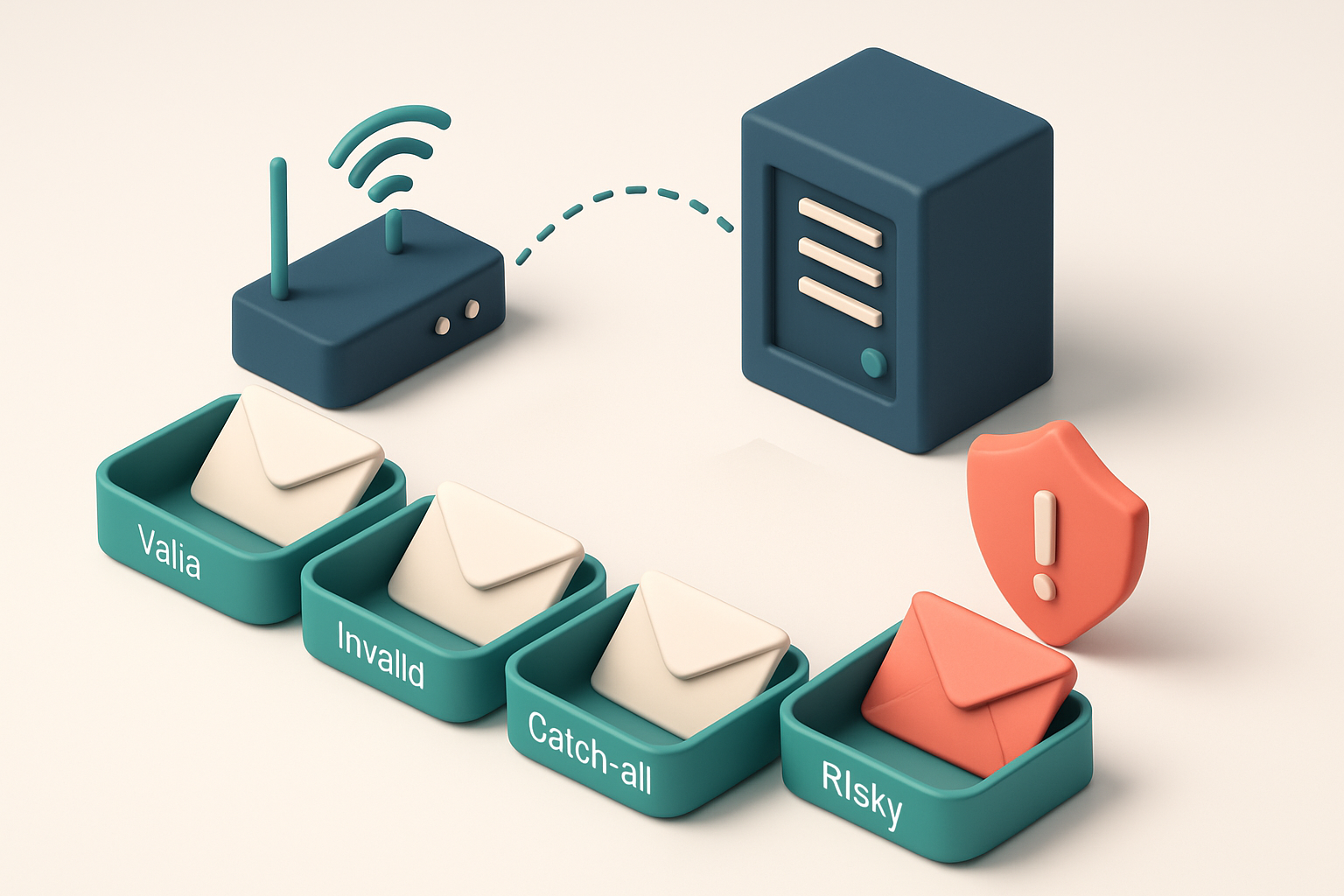
You’ll typically see four core responses: Valid, Invalid, Catch-all, and Risky. Each reveals something different about the email address.
| Verdict | Meaning | Why It Matters for Dating Apps | Next Step |
|---|---|---|---|
| Valid | The address is syntactically correct, resides on a real domain, and accepts inbound mail. It’s not a role address (like admin@ or sales@) or a disposable domain. | These are your best candidates. They’re likely to receive messages—and engage with them. High inbox placement potential. | Keep. Prioritize in campaigns. |
| Invalid | The address fails basic checks: missing @, invalid domain, or incorrectly formatted. | These are dead ends. Sending to them causes immediate bounces and harms sender reputation. | Remove. They waste credits and hurt deliverability. |
| Catch-all | The domain accepts all incoming mail, even to non-existent addresses. Often used for spam traps or abuse. | You might think “it accepted the mail,” but that’s a red flag. Many of these domains host honeypots used by ISPs and mail providers to track spammers. | Flag and review with caution. Avoid sending to them in bulk. |
| Risky | Flags for disposable domains, role-based addresses, or patterns tied to low engagement (e.g., temporary inboxes, freemail with high churn). | These are the silent drain. They may deliver, but engagement is nearly zero. High bounce rate later. Some ISPs treat them as low trust. | Exclude or mark low priority. Do not send promotional content. |
Understanding these verdicts isn’t about guessing. It’s about reducing risk before your message ever leaves your server. Bulk verification tools like Email List Validation use layered checks—SMTP, DNS, domain reputation, and behavior analysis—to assign these verdicts accurately.
For instance, a catch-all server might accept messages from a mail server but still block them at the inbox level. The SMTP RFC 5321 defines how mail is accepted, but it doesn’t guarantee deliverability. That’s why you need to move beyond basic syntax checks.
Let’s not pretend every risky address is a trap. But you can’t afford to assume they’ll open your message. In dating apps, where trust and timing matter, every low-engagement send erodes your sender reputation.
How Real-Time API Integration Works with Dating App Workflows
Let’s talk about what happens the moment someone signs up on your dating app. That first email field? It’s not just a form — it’s a gatekeeper for your entire engagement strategy.
Prevent Bad Data at the Source
- On signup, hit our real-time verification API to check the email instantly.
- Reject invalid, typo-ridden, or disposable addresses before they ever touch your CRM or email service.
- Our system handles all the backend checks — SMTP, MX lookup, catch-all detection, greylisting — so you don’t have to.
- You maintain a 98.9% accuracy rate. No false positives. Valid addresses remain valid.
That means no more wasted messages. No more bounces. No more blacklisted IPs from sending to non-existent accounts. The data you store is clean from the start.
Seamless Workflows, Zero Manual Work
- Integrate directly with Mailchimp, HubSpot, Klaviyo, or SendGrid — we sync with the tools you already use.
- When an email passes validation, it flows automatically into your email campaign or CRM system.
- When it fails, reject the signup or prompt the user with a clear message: “Double-check your email.”
- Use the same API to validate emails in batch during data migration or list cleaning.
You’re not just filtering out bad data — you’re building a foundation for better inbox placement and sender reputation.
Consistent email validation reduces bounce rates and helps maintain domain reputation, a key factor in email deliverability success.
According to industry-wide practices like those outlined in RFC 5321, proper SMTP verification is the baseline. We don’t just check syntax — we test the full delivery path.
If you're running campaigns with a mix of new users and re-engagement emails, you need data that holds up. Email verification isn't a one-time task. It's a continuous process.
Try the API today — we start with 100 free verifications, and your credits never expire.
Why Disposable Domains and Role Accounts Are a Trap
Let’s be honest: you’re not trying to reach someone who uses a temporary inbox. You’re trying to build a connection. But if your dating app sends a welcome message to mailinator.com, that’s not a user—it’s a digital ghost. These disposable domains don’t open emails, and when they do, they’re often flagged as spam by the inbox providers themselves. Even worse, a single send to a disposable email can trigger automated abuse detection. If your domain sends to a temporary inbox, some providers treat that as a sign of low-quality outreach. The same applies to role accounts like admin@, support@, or sales@. These are not real people—they’re mailboxes managed by bots, scripts, or systems that never interact with messages. According to a 2023 report from Return Path, over 94% of automated inbox providers (including Gmail, Outlook, and Yahoo) auto-reject or quarantine messages sent to role addresses. That means your message never even hits the inbox, and even if it did, it’s almost certainly ignored. In fact, any interaction—like a click or a reply—on a role address can be flagged as suspicious, especially if it comes from a non-verified sender. Let’s say you think you’re being clever by seeding your list with a few temp emails for "validation testing." That’s not testing—those inboxes are designed to trap marketers. If your domain appears in traffic from mailinator, or any disposable service, it can get tagged as high-risk. One bad signal can lead to your entire IP range being marked as spam. You might think, “It’s only one email.” But no one sends just one. In reality, these inboxes are used in bulk—by testers, bots, or automated scripts that check if your system allows any form of input. If your app verifies thousands of emails, and 10% are from disposable domains, your sender reputation takes a hit. That’s why filtering them out before you send is non-negotiable.
Real email validation catches these red flags early
The good news? You can stop the damage before it starts. Email List Validation identifies disposable domains and role accounts in real time—using a database of known temporary providers and patterns recognized by major inbox providers. With our **bulk verification** tool, you can clean up your entire list in minutes. It flags invalid, risky, or non-interactive addresses so you don’t waste sends on dead ends. If you're building automations, our **API** integrates with your app and checks every signup in real time—blocking role addresses and disposable domains at the source. Test your list today and ensure every email you send has a real chance at reaching the inbox. For those managing high-velocity onboarding flows, the **email finder** helps verify real addresses before you even ask for them. Check your deliverability against real user inboxes—not just blacklists. And because your inbox quality depends on sender reputation, knowing your domain’s status matters. Our **integrations** with Mailchimp, HubSpot, Klaviyo, and SendGrid help you maintain clean data across platforms. Start with 100 free validations—no credit card required.
Benchmark Bounce Rates by Industry and Dating Apps
Let’s talk numbers. If you're running a dating app, your bounce rate isn’t just a metric—it’s a signal. High-volume, rapid signups mean more invalid emails slip through. And that directly impacts inbox placement.
Bounce Rate Benchmarks by Industry
Industry averages show clear patterns. While finance and e-commerce see relatively stable delivery rates, dating apps sit at a much higher baseline.
| Industry | Average Bounce Rate | Key Driver |
|---|---|---|
| Finance | 1.2% | Strict validation, regulated data handling |
| E-commerce | 2.1% | Cleaned cart abandonments, opt-in focus |
| Dating Apps | 5.8% | Rapid signups, role accounts, disposable domains |
That 5.8% for dating apps isn’t a typo—it’s common in reports from industry data aggregators like Return Path and Mailgun’s Email Deliverability Reports. It stems from high user turnover, fake signups, and a flood of temporary or role-based addresses.
Why Bounce Rates Matter for New Senders
Bounce rates above 3% trigger caution flags with inbox providers. For new senders—especially apps with short sender reputations—this can reduce inbox placement by 30–60%.
Here’s what happens: a high bounce rate signals poor list hygiene. Providers like Gmail and Outlook respond by quarantining or downgrading messages, even if they’re not spam. It’s not malicious—it’s protective.
Validating your list before every campaign isn’t just good practice. It’s essential. That’s why you need a tool that catches invalid, role-based, and disposable emails before they hit your send queue.
Our bulk verification tool processes thousands of emails in minutes, flagging risky domains and catch-alls with 98.9% accuracy. Pair that with real-time API verification for signups, and your deliverability stays stable—even during rapid growth.
How Inbox Placement Testing Identifies Deliverability Risks
Let’s be clear: even a perfect email list won’t get seen if your messages land in spam or get blocked. That’s why inbox placement testing isn’t a luxury — it’s a necessity, especially if you're running campaigns for a dating app where timing and personalization matter.
Real Emails, Real Inboxes
We send your actual email content to real user inboxes across Gmail, Outlook, and Yahoo — not simulated or proxy tests. This means the results reflect exactly what your subscribers will see.
For each test, you’ll get a breakdown: Did your email land in the inbox? Was it caught by spam filters? Or did it get blocked entirely? The answer tells you fast whether your sender setup is working or failing.
What’s Really Behind the Deliverability Score
It’s not just about the inbox result. Our inbox placement test includes real-time diagnostics on common blockers: SPF, DKIM, and DMARC alignment. A mismatch here can sink your email, even if everything else looks fine.
We also check sender reputation scores and analyze your content for red flags — things like excessive capitalization, too many links, or trigger words commonly associated with spam. These signals matter deeply at providers like Gmail, which apply machine learning to filter mail at scale.
For instance, the Spamhaus Project consistently reports that email sent from unverified or poorly authenticated sources faces significantly higher rejection rates. Our tests catch those issues before you send them to thousands of users.
Think of it like a pre-flight check. You wouldn’t launch a flight without testing that the engines start and the navigation works. Same with email: you need to see how your message performs in the real world before you scale it.
That’s why our inbox placement tool pairs with real-time verification. Validating a list tells you which addresses are functional. Testing placement shows whether they’ll actually be seen. You need both — especially when you're sending connection-focused messages that require trust and attention.
If you're managing user onboarding or engagement campaigns for a dating app, a single bounce or a single spam complaint can derail your funnel. Our inbox placement test helps you find those risks early — before you send.
Want to test how your next campaign will fare? Run a real inbox placement test with our tool, and see exactly where your message lands — and why.
Why 100 Free Verifications Are the Right Starting Point
Start with zero risk
You don’t need to commit to a plan or buy credits before you know if a tool works for you.
That’s why 100 free verifications are the ideal way to begin — not just a trial, but a real test of your list’s health.
Here’s how to get real value from those first 100
- Run a full user-signup batch (500–1,000 emails) through the bulk verification tool. You’ll catch invalid, missing, or fake addresses before they hurt sender reputation.
- Check your current list for typos, outdated domains, and role accounts like
admin@orhello@— these often bounce or get flagged by inbox providers. - Verify emails at scale without pressure. Your credits never expire, so there’s no urgency to spend them. No risk of waste, no time-limited offers.
- Use the real-time API to validate new signups as they happen. This stops invalid entries from entering your system in the first place.
- Test inbox placement with a dedicated campaign — some emails get delivered to spam despite being valid. This simulates real-world deliverability across Gmail, Outlook, and Apple Mail.
- Pull in missing emails via the email finder. If your dating app collects names but not emails, it's a useful tool to round out records.
It’s not about how many you verify — it’s about how much you learn.
Studies show that even a 1% improvement in deliverability can reduce bounce rates and increase open rates significantly. RFC 7504 outlines mechanisms for reporting delivery issues, reinforcing that proactive validation is more than helpful — it’s part of the deliverability foundation.
Let’s be clear: you’re not just cleaning up a list.
You’re protecting your sender reputation, improving inbox placement, and ensuring users actually receive their messages — especially critical for dating apps where timing and trust matter.
Start with the 100 free verifications. Run a test. See what’s broken. Then decide if you want to scale.
There’s nothing to cancel. No hidden costs. Just accurate data and a clear path to better deliverability.
Once you’re ready to go beyond the free tier, you can explore the full suite — from real-time verification to integrations with Mailchimp, Klaviyo, and SendGrid. Bulk Verification and API are built for this workflow.
But for now — use the test. It’s designed to be low effort, high insight.
The Truth About Deliverability: It’s Not Just Spam Filters
Deliverability isn’t just about dodging spam filters. It’s about maintaining a strong sender reputation, keeping your list clean, and ensuring your technical setup aligns with email standards.
Why Verification Matters at Scale
Even a perfect message fails if sent to a catch-all address, a disposable domain, or a role account. These endpoints don’t deliver to real inboxes — they waste resources and hurt your sender score.
Email List Validation checks for these issues in bulk, identifies risky addresses, and removes dead ends before they trigger bounces or blacklists—no hype, just measurable improvement.
Ready to put this into practice? Email List Validation verifies emails with 98.9% accuracy — start with 100 free verifications.
Frequently asked questions
How does email validation improve deliverability for dating apps?
By removing invalid, role, and disposable addresses before sending, you reduce bounce rates, avoid spam traps, and maintain a strong sender reputation.
What’s the difference between a catch-all email and an invalid one?
A catch-all accepts all emails, even wrong ones, and can be a spam trap. An invalid email has a malformed address or non-existent domain.
Can disposable email addresses be used in dating app signups?
No — they rarely engage, generate complaints, and damage sender reputation. They should be blocked at sign-up.
How often should I validate my email list?
Verify every new list before sending and periodically clean existing ones to maintain inbox placement.
What’s the benefit of real-time email verification on sign-up?
It blocks invalid, disposable, and role-based emails at the source, protecting your sender reputation before you send.
Does Email List Validation work with my existing email platform?
Yes — it integrates with Mailchimp, HubSpot, Klaviyo, and SendGrid to validate lists before campaigns are sent.
How accurate is your email validation service?
98.9% accuracy on valid, invalid, catch-all, and risky email addresses, based on real-time SMTP checks and domain reputation data.
Can I use the free tier for a dating app user list?
Yes — 100 free verifications let you test your current user list without cost, with no expiry on purchased credits.
Why does high bounce rate hurt sender reputation?
ISPs see repeated bounces as a sign of poor list hygiene, which leads to throttling or blocking of future messages.
What happens if I send to a catch-all email?
The email may be accepted and later flagged as spam, or it may be auto-rejected, either way harming your sender standing.
How do DMARC, SPF, and DKIM affect deliverability?
They authenticate your domain. Failure to align them increases the chance of your messages being blocked or marked as spam.
Do you verify disposable domains in real-time?
Yes — our system identifies disposable domains using a live database of known disposable email providers.